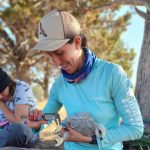
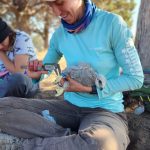
 On Thursday, April 23, the Redbud Audubon Society will host a zoom program presented by Elizabeth Meisman focusing on the Northern California Osprey Collaborative, a new, community-driven raptor research initiative working to better understand and conserve breeding Ospreys across this region. The program will start at 7 p.m. and registration can be accomplished by going to Redbud’s website and clicking on the link on the home page; or by clicking on the link in this newsletter if you receive it by email.
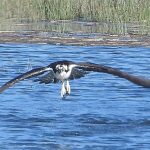 The program will include fascinating information about the iconic Osprey along with images and a video. There are few sights more thrilling than an Osprey hovering above the water, wings beating steadily, before plunging feet-first to capture a fish. Known as the “fish hawk,” the osprey is a powerful symbol of healthy waterways—and thanks to decades of conservation, it’s also one of our great wildlife success stories.
Created to help fill important knowledge gaps in regional raptor research, the Osprey Collaborative project aims to expand monitoring efforts beyond Humboldt Bay to coastal areas, reservoirs, and river systems throughout Northern California, including areas like Lake County and Clear Lake. Anyone who drives around this area has probably noted numerous osprey nests here, everywhere from the City of Clearlake to Lakeport, the northshore and beyond.
This research is led by Elizabeth Meisman at Cal Poly Humboldt and is building a collaborative network of researchers, community scientists, and youth groups. “We are currently seeking volunteers to help locate Osprey nests and assist with monitoring throughout the breeding season. Whether you have a known nest to report or are interested in participating in nest monitoring, your contributions can make a meaningful difference,” Meisman explained.
In addition, a statewide survey of breeding Peregrine Falcons is underway and also welcomes volunteer participation.
Lizzi Meisman is a wildlife biologist working across California on a variety of ecology, conservation, and long-term monitoring projects. She is currently an NSF Graduate Research Fellow in Dr. Matt Johnson’s Habitat Ecology Lab at Cal Poly Humboldt. Her master’s research aims to investigate habitat selection of Swainson’s Hawks breeding in the Butte Valley.
A dedicated conservation communicator and mentor, Lizzi provides extensive training opportunities through hands-on research, supervising student interns conducting independent senior projects as part of the long-term monitoring program. Each season, she has coordinated and trained dozens of volunteers, fostering the development of early-career scientists and building capacity for collaborative field research. She regularly engages landowners, youth, and community members through presentations, classroom visits, birding trips, and banding demonstrations, and shares findings with the broader scientific community through publications and conference presentations.
If you are interested in contributing to community-based raptor research—or if you know of any Osprey or Peregrine Falcon nests please share observations or questions at: NorCalOsprey@gmail.com.
Ospreys sit at the top of the aquatic food chain, feeding almost exclusively on fish. This makes them excellent indicators of environmental health. When osprey populations are thriving, it often reflects clean water, abundant fish, and functioning ecosystems.